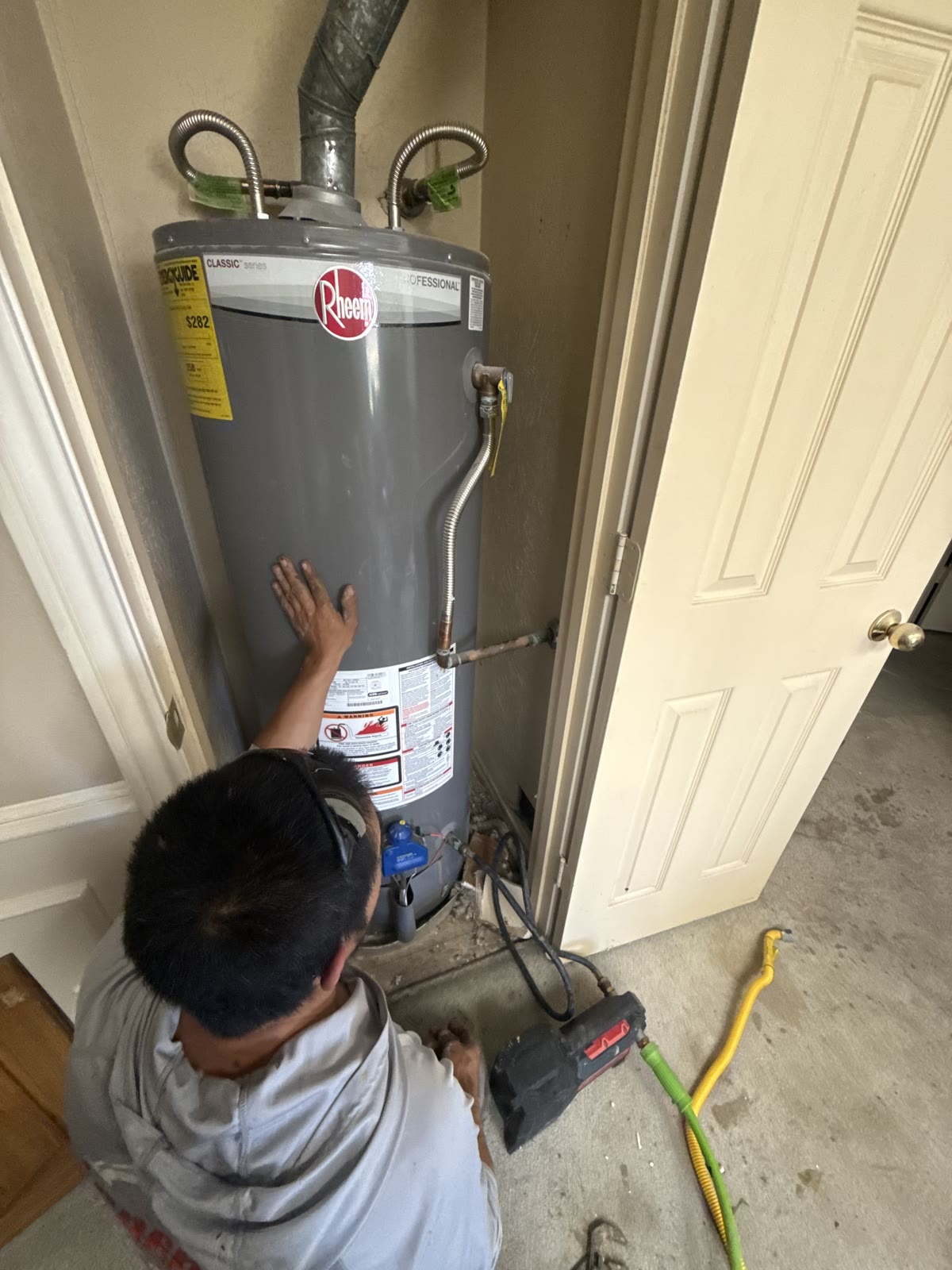
The "tankless or tank?" decision is one of the bigger plumbing investments a DFW homeowner makes. We install both — hundreds of each per year — and the answer isn't always tankless. Here's the honest comparison.
TL;DR
- Tank wins on: up-front cost, simplicity, retrofit ease, repair affordability
- Tankless wins on: longevity, energy efficiency, endless hot water, space savings
- Texas-specific factors: hard water punishes tankless harder than tank; mild ground temps favor tankless efficiency
Up-front cost in DFW
| | Tank | Tankless | |---|---|---| | Equipment | $600–$1,800 | $1,500–$3,500 | | Installation | $600–$1,200 | $1,500–$3,000 | | Code upgrades | $200–$600 | $800–$1,800 | | Total all-in | $1,400–$3,600 | $3,800–$8,300 |
The tankless installation cost is higher because it almost always involves:
- Larger gas line (3/4" minimum, often 1")
- New venting (Category III stainless)
- 120V outlet at the unit
- Often relocating the unit
Lifespan
- Tank: 8–12 years average in DFW (hard water shortens life)
- Tankless: 18–22 years with annual flushing
Over 20 years, you'll probably buy 2 tank water heaters or 1 tankless. That's the math that drives the long-term cost story.
Energy efficiency
A modern tank unit at 0.62 UEF vs. a tankless at 0.95+ UEF is a real difference. Real-world DFW savings for a family of 4:
- Gas: $80–$200/year savings with tankless
- Electric: $100–$300/year savings with tankless
These numbers vary widely with usage. A vacation home barely benefits; a large family hits the high end.
Performance differences
Hot water capacity
A 50-gal tank gives you ~30 gallons of usable hot water before recovery. That's 1.5–2 simultaneous showers or one shower + a load of laundry.
A properly sized tankless gives you essentially unlimited hot water — but the limit is flow rate, not volume. A standard 199k BTU unit handles about 5–7 GPM at our typical 65°F groundwater temp. That's three showers running simultaneously.
Cold-water sandwich
The "cold sandwich" — when you turn off, then back on — happens with all tankless units. Modern recirculation models have largely fixed this with a small buffer tank or recirc pump.
Recovery time
Tank recovery is the killer if your family runs out — 30–45 minutes for a 50-gal gas tank to reheat. Tankless never runs out, so recovery isn't a concern.
Texas-specific gotchas
Hard water
DFW water averages 8–10 grains per gallon hardness. Tankless heat exchangers scale up faster than tank coils. Annual descaling flushes (we charge ~$200) are mandatory if you want to hit that 20-year lifespan.
A water softener helps both, but is essential for tankless to hit warranty.
Mild groundwater
This is where tankless shines in Texas. Our 65–70°F groundwater (vs. 40°F in northern states) means tankless units don't have to raise temperature as much, so they hit higher GPM ratings and run more efficiently.
Power outages
Tank water heaters keep working without power for 1–2 days (you have whatever's already hot). Tankless units shut down immediately during outages — even gas tankless units need 120V for the controller and igniter.
Which one is right for your house?
Choose tankless if:
- You're staying in the house 8+ years
- You have natural gas with adequate line size (or willing to upgrade)
- Your water heater is in a tight closet
- Your family runs out of hot water
- You like the "set and forget" 20-year horizon
Choose tank if:
- You're selling within 5 years
- Up-front cost is a real constraint
- You don't have natural gas (or won't upgrade gas)
- You have a backup generator transfer switch (tank works through outages, tankless doesn't without backup power)
- You have very low water usage
Hybrid option: heat pump water heater
Worth mentioning: heat pump water heaters (Rheem ProTerra, AO Smith Voltex) are getting big in Texas. They're 3–4x more efficient than electric tanks, work in any garage with reasonable headroom, and qualify for federal tax credits. We're installing more of these every year. Drawback: they only work for electric installs and need a warm space (a Texas garage is usually fine).
What we recommend in DFW
For most homeowners staying 5+ years with existing gas service: tankless, sized correctly, with annual flushing.
For homeowners with electric service and no plans to convert: heat pump water heater.
For short-term owners or budget-constrained: standard 50-gal gas tank with proper code-compliant install.
Get a real quote
Call us — we'll come out, look at your gas line, your venting, your usage pattern, and give you a flat-rate number on whatever option fits.